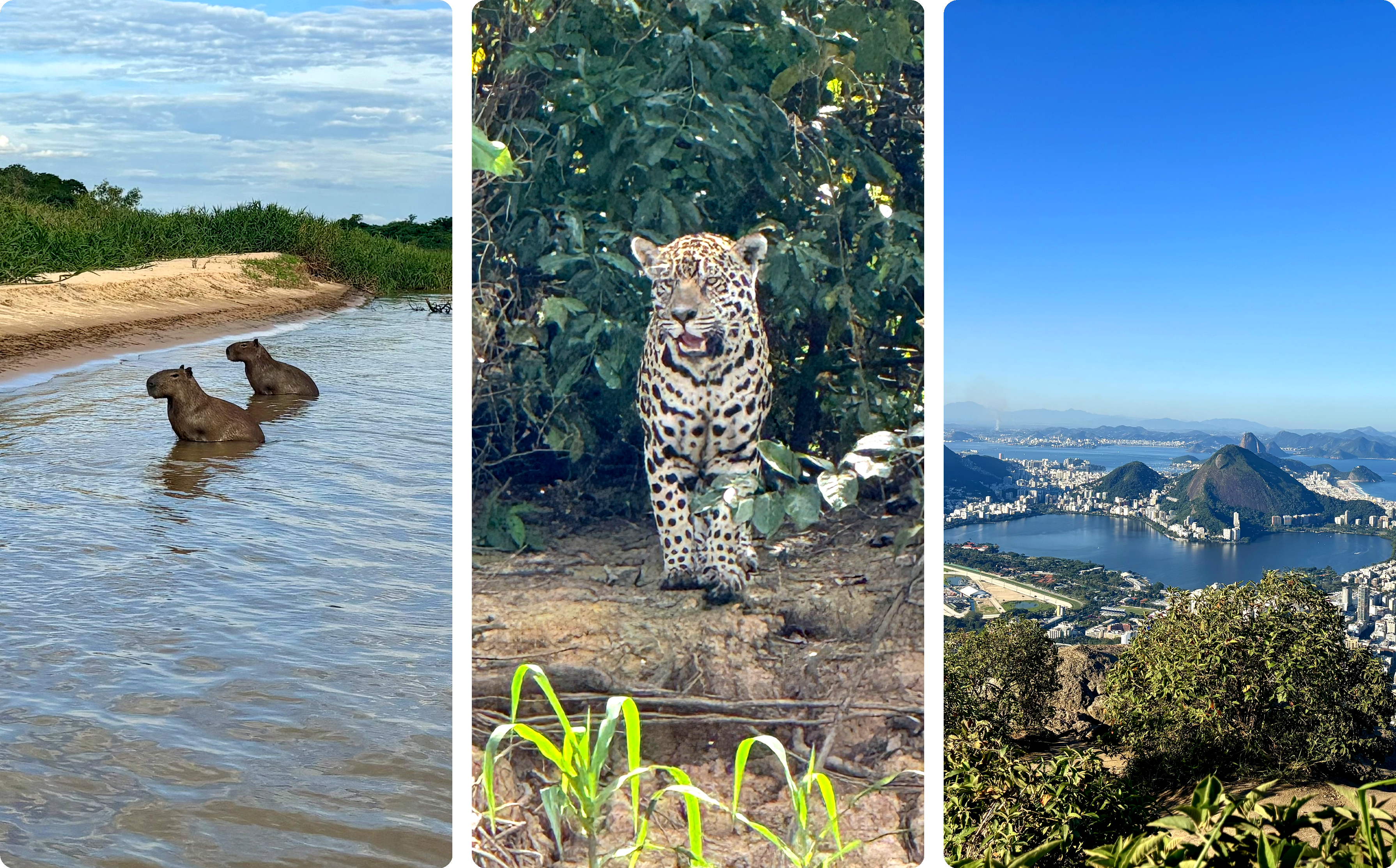
The Meat of the Story (Brazil)
-
I had read about the Amazon forest burning, and the deforestation rates climbing under Bolsanaro, but nothing had prepared me for the dichotomy of the Pantanal (the floodplains of the Amazon, where the wildlife was insane, albeit so were the rocket-high accommodation rates) vs the actual Amazon rainforest by Manaus (where, even after a 3 hour journey via multiple boats and cars into the Amazon, the forest was clearly fragmented and quiet; we saw as many cleared land parcels as we did animals). For three imperfect but interesting insights into why this is:
-
[documentary] The Territory: Many Brazilians feel that have a right to "civilize" land and "make it productive." They don't understand why/how Indigenous groups with so few members need so much land. This has interesting links to the "cowboi" culture of the right, and the high cultural status of cattle ranchers. This documentary follows a group of indigenous Brazilians trying to fight back and defend their protected forest.
-
[podcast] Missing in the Amazon" (6-episode mini-series within Off Duty | The Guardian Investigates): On the dangers of environmentalism and the high murder rate among those who try to protect the forest, with a specific investigation into the disappearance of a (British) Guardian reporter and a Brazilian indigenous rights defender.
-
[book] How to Save the Amazon by Dom Philips: Dom is that missing (spoiler alert: murdered) journalist, who died while reporting for this book. His friends club together to finish the book on his behalf. The book itself is uneven and poorly edited, but the content still makes for fascinating insights into how deforestation works. Among things I learned: Most deforestation begins with illegal gold mining, which is often run by violent, moneyed cartels (with drug lords coming from Colombia/Peru), who dump the mercury byproduct into the rivers and then build roads to move mined gold out. Then, once those roads are there, (formerly) landless Brazilians clear out more land near the roads, to create pastureland for cattle ranching. The vast majority (50-98%, large range because data is poor) of beef from Brazil (which also exports to the US/Europe) is from deforested land. And government records of land ownership are poor and patchworked too. In an attempt to regularize things, under Lula (!), one could show that you have been actively using a patch of land for X years and then gain rights to it. But many choose never to regularize ownership anyway, to avoid paying taxes. The entire cycle was horrific, and Werner abstained from eating any red meat the whole time we were in Brazil as a result.
-
-
[movie] The Secret Agent: A highly acclaimed, stylized movie about the wild, corrupt, and violent days of the 1970s. I thought it was fine, but critics loved it (98% on RT).
Canada is... Horny?
-
[TV series] Heated Rivalry: Obviously, for the sake of cultural immersion, I watched this soft-core porn romance series about two rival hockey players. Grab your popcorn.
-
[book] All our wrong todays by Elan Mastai: Written by a Canadian author, this is one of my favorite reads of the year! There's time travel, deprecating humor, and a love story.
On the many faces of tech
-
For two joyous uses of tech:
-
"The hunt for dark breakfast" by Ryan Moulton: The writer creates a theoretical model of breakfast, mapping out the "vector space" to derive what breakfasts must exist yet remain undiscovered.
-
A physicist rigged his pet hamster's wheel to upload to Strava. It runs surprisingly far every night" (Runners World): Yes, that headline more or less sums it up. But the full article (and photos!) are still worth a laugh/read.
-
-
[podcast] Shell Game (Season 2): Perhaps already slightly out of date, but in early 2026, this was pretty cutting-edge journalism: The host (a former YC startup founder, and a regular Wired contributor) tries to build a startup company with only him and AI agent colleagues. Hilarity ensues.
-
[podcast] Alternate Realities (mini-series within NPR's Embedded): A gorgeous, vulnerable, and thoughtful insider take. A journalist tries to understand how his father has become a conspiracy theorist and lays bare how it destroys his family. Certainly the best media I've consumed re: conspiracy theorism.
On nature
-
[book] Light Eaters by Zoe Schlanger: "WTF" was basically my entire feeling reading this book, which reports on the cutting-edge science of "plant behavior," i.e. how plants grow, "see", "hear", and interact with other plants (or with you). Sunflowers crowd out non-kin sunflowers but make room for their siblings. Plants start growing stronger (not taller) if you touch them. A rainforest plant mimics the look of other plants around it... sometimes appearing as multiple plants, if it's surrounded by different species. And so much more.
-
[book] Wilding by Isabella Tree: The story of a British couple who decide to rewild their (unproductive) farmland. They fall into deep research wormholes like: What are we "returning" to? What did Europe look like "before"? The two big takeaways for me were: (1) Dense canopy forests are often not wildlife dense (grazers are important for ensuring there are shrubs and hedges which promote more wildlife); and (2) Beavers are fkn rad.
- Related fiction reading: [book] Once There Were Wolves by Charlotte McConaghy: On the (imagined) difficulties of reintroducing wolves to the Scottish highlands and the pushback from local ranchers. While this isn't McConaghy's strongest work, she's still excellent at creating strong characters and a deep sense of place. And it made me think a lot about the neighborly struggles mentioned in both the Amazon books and in Wilding.
-
[book] Raising Hare: A Memoir by Chloe Dalton: A quiet, lovely, meditative book on a woman with a fast-paced career, who suddenly slows down (and learns to let go) to care for a wild European hare.
-
"Secrets of the bees: Revealing the sneaky genius of nature’s brightest thinkers” (Nat Geo): Similar in vibe to Light Eaters, it's a fascinating look into bee behavioral research, and a slight balm to all our fears about bees disappearing: it turns out they can learn and adapt reasonably well!
On health and "wellness"
-
"Our bacteria are talking. We’ve just begun to understand what they’re saying" (NYT): A fascinating piece on our microbiomes and how many "diseases" or illnesses may be related to our bacteria... with the corrollary that maybe how we treat illness needs to change.
-
[podcast] "The sneaky way companies companies get new chemicals into our food" (Planet Money): Since the lettuce cyclospora outbreak, there's been a lot more coverage of the failures of the FDA. But even before then, Planet Money did some great (and scary) reporting on how processed food manufacturers can include all kinds of new formulations/ingredients in their products without any food safety checks at all. (They can just self-report it as safe.) The piece follows one specific incidence resulting in 42 people having their gall bladders removed. An additional horrifying bit to me is how little these people were then compensated (for, again, never having gall bladders again and therefore not being able to eat most foods): $100,0000. This was also meant to cover all (US!) medical expenses, in addition to quality of life impacts. WTF.
-
Specifically regarding women's health:
-
"The year all my friends got botox" (The Cut): A thoughtful essay on aging and feminism, as well as an interesting peek into Gen Z as they inch towards the big 3-0. (Are Gen Z more likely to embrace Botox because they haven't grown up with the visual horror stories/faces of botched Boomer Botox?)
-
"Inside the perimenopause industrial complex" (Wired): Related to the above, hormone replcemement treatment (HRT) is all the rage these days, and again seems to feature a generational divide: Unlike their elders, millennials now (sometimes as early as in their 30s) are clamoring for HRTs, following research that HRT seems to carry all kinds of anti-aging benefits: fewer fractures, lower rates of dementia, fewer mood swings, etc. Yet capitalist forces may be pushing things a bit too far.
-
"The internet is obsessed with ovulation” (Atlantic) and “Who am I without birth control?" (NYT): Under RFK, just as men have become obsessed with testosterone, women have become obsessed with their natural period cycles. But also, choosing to go off birth control has begun to read as conservative. I'm not sure what to make of this all, except that... I guess we're still socially policing women's decisions about their bodies. Cool, cool.
-
Plays / Theatre (incl. US & Canada)
-
[musical] Operation Mincemeat: What a delightfully manic, hilarious show, featuring a small 5-person cast who together play over 80 characters. It's a tightly choreographed and absolutely insane (and true!) WW2 story of how the UK fooled the Nazis by floating a planted corpse with fake intel into enemy lines.
-
What got me to watch it was this plus this amazing essay/review: Why on earth have I seen the same broadway show 13 times? An investigation" (NYT) itself an endearing, funny, and heartfelt contemplation of middle-aged womanhood and the bittersweet grief od getting older, where intense, all-consuming desire becomes a rare, treasured surprise. A favorite line: "Right now I am in the gloaming of all that — in the perimenopause of all my passions, a time when I still remember what it is to want, but from the shoreline. This might never happen again to me... It becomes rarer and rarer to be struck in the heart by something that consumes you, and one day you forget that it used to happen at all."
-
PLUS! Apparently the show actually led to a semi-anonymous woman being identified and recognized for her contributions in that important war effort: How a Broadway musical revealed a family's World War II spy secrets" (NYT)
-
-
[play] I’m Almost There: A one-man, sort-of-musical show, loosely following the Odyssey, in which one a gay man tries to get coffee with a new love interest. It's hard to explain, but it was incredibly sparse and imaginative, and a world away better than the Nolan flick. (Sorry not sorry.) Developed by the producers of Fleabag and Baby Reindeer.
-
[circus] I saw a good (not great) circus show in Montreal, but one act (doubles oscllinating pole) had be absolutely floored. It's so beautiful, and luckily for the world, the entire act is available on Instagram here.
-[play] In Cape Town, I saw the Aussie play Prima Facie, which had me absolutely reeling. It's a 2+ hour one-woman show, about how the legal system tries sexual assault.
Other random recs (misc.)
It's been a BIG reading year for me, and here have been some great finds, not yet mentioned above:
-
[books] On the porous borders of identity: Both The Slip by Lucas Schaefer and Immaculate Conception by Ling Ling Huang were wild rides, and both highly recommended.
-
[book] On good and evil: The Red Rising series by Pierce Brown was separarently recommended to be by two of my Oxford Masters in Public Policy classmates, and I get why. Imagine Hunger Games, but with more high-level deal-making and political maneuvering.
-
[book] Romcom, with an emphasis on the com: Roland Rogers isn't dead yet by Samantha Allen had me literally LOLing, with hilarious takes on how one might have sex with a ghost who can control electric pulses. Yep...
-
[podcast] "100 Objects #10: Nunchaku" (99% Invisible): Sort of about nunchucks, but mostly about the cultural importance of Bruce Lee. I was just too young to have remembered/lived this, but as a Cantonese-American, I can't believe I didn't know more. Such a great story!