Can I have a word?
- Why Does AI Write Like... That?" (NYT Magazine): A writer's dissection of what makes AI writing so distinct -- and how its widespread use has led to the globalization of local language idiosyncracies. I loved the example of the Nigerian "delve" and the British MPs' use of "I rise to speak."
- "Unparalleled Misalignments" (Ricki Heicklen): Just the most joyous list, for any of my fellow Wordplay/pun enthusiasts.
- Who killed the narrative podcast?" (Rolling Stone): It seems the age of peak podcast is over... and there's an (economic) reason for that. Now it's all talking heads.
- [podcast] Normal Gossip (h/t Urmila) - Uneven but frilly fun, the host shares a different (listener-submitted) gossipy story each episode.
I'm no expert but...
-
[podcast] The Retrievals Season 2: The Retrievals did it again with this new season, tackling a new source of (ignored) women's pain: the C-section. Apparently, epidurals fail a surprisingly high percentage of the time... and doctors simply don't listen enough to their female patients to do something about it (put the patient under general anesthesia). It is also an inspiring story of how big of a difference a normal citizen can make: The star of the story is a British (non-doctor) mom who in the end helps change the standards for all UK births/C-sections (!)
-
Parallel parking contest: Yes, There's a Parallel Parking Championship, and I was a Contender" (Car and Driver): A fun example of how locals can turn the mundane into a community bonding experience. This gave me so much joy (even as a pretty average parallel parker).
-
[book] Dead Money by Jacob Kerr: A fun whodunnit based in Silicon Valley, written by one of Airbnb's earliest employees. It features a lot of SF nonsense and general on-target panning of the tech industry.
Wanna bet?
Sports betting has got to be one of the biggest scourges of our modern times. Two particularly grim listens/reads:
-
[podcast] Against the Rules: Fans: The newest season of Michael Lewis' podcast is excellent, full of great, narratively immersive and investigative journalism. As someone who has never placed a sport bet, I learned a LOT about the industry... and about what different countries have learned about how to regulate (or ban) the industry. It made me think a lot of how we (including me!) were probably wrong about legalizing marijuana.
-
The ruinous growth of sports betting in South Africa" (Our Long Walk) - with some shocking stats and charts on what % of SA household incomes is spent on sports betting.
Conservation, Locals & Money (travel stories)
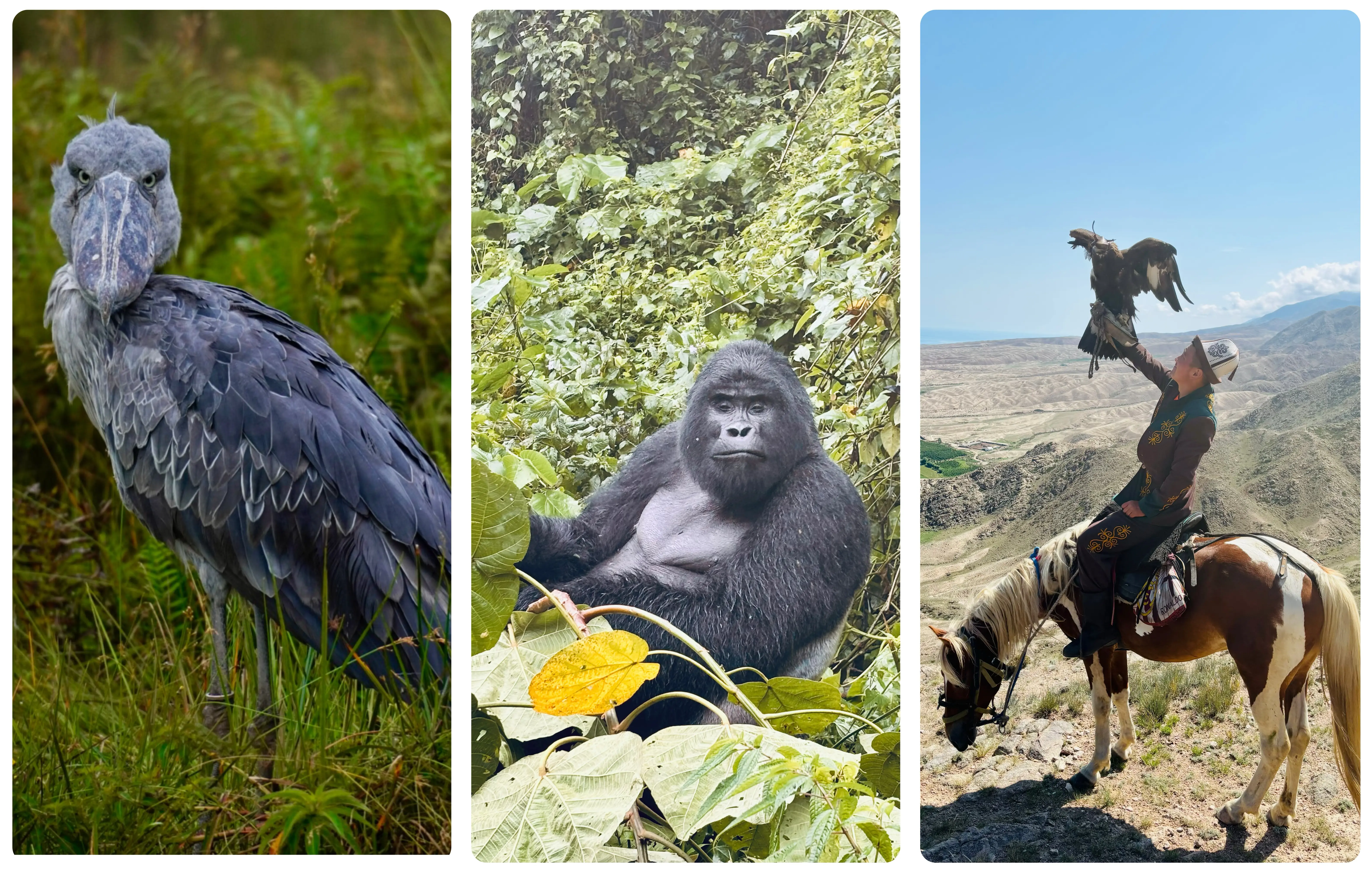
A lot of my travels this year were closely linked to conservation including a month doing coral reef science/restoration in Raja Ampat, hunting with golden eagles in Kyrgyzstan, and chimpanzee & gorilla trekking in Uganda. And seeing how the different countries have handled conservation challenges was fascinating.
Indonesia
- "Trouble in Paradise" (Oceanographic Magazine): We read this article before our volunteering trip, and were stunned/saddened to learn that a mass bleaching event had recently happened by Arborek. One likely reason: cyanobacteria, from human feces, leading to a growth in coraline algae that suffocates coral. This accompanied a massive growth in tourism in Raja, particularly from boats and liveaboards, which operated without regulation on their waste disposal methods... so were likely just dumping untreated waste right into the marine conservation park. It once again highlighted the tension between tourism (even wildlife-related tourism, as these were divers) and conservation.
- Battle to save Indonesian 'paradise' as nickel industry expands into Raja Ampat in Papua" (ABC): Another point of tension? Zero-emission EV vehicles vs the environmental cost of batteries (nickel-mining). While we were there, this particular nickel mine got shut down, but raised the question all the same.
- Mining was also on the mind of Papuans outside of Raja, where locals contend that Jakarta sees the island as a place to extract natural resources. I watched/read a bunch of videos/articles about the West Papuan freedom fight, to extricate themselves from what many view as Indonesian colonialism. (Sorry, been too long so I no longer have the exact links!)
- Child of the Jungle by Sabine Kuegler: The true story memoir of one girl's childhood in the deep Papuan Highlands, where her missionary parents made first contact with a local indigenous tribe. She's of course not a reliable narrator (it's based on childhood memories, and she has a religious angle), but the book is great at transporting the reader into that rainforest world. And, if read with a critical eye, it raises interesting ethical questions about first contact, missionary work, and the right of warring indigenous cultures to maintain their culture (when can/should culture evolve)?
- A conservation success story: In case you missed it, green sea turtles went from being endangered to least concern! So it can be done... at least for cute, charismatic species?
Uganda
- As I traveled around Uganda, I noticed just how well poised local communities were to capture some of that wildlife tourism money. In nearly every town we passed, locals were running "community-led tours," to do birdwalking walks, as well as to learn local crafts (e.g. basketweaving). The proceeds would be split between community members and village maintenance (they were shockingly clean!). This, in turns out, is intentional: it aligns economic incentives for locals to preserve neighboring national parks & police poaching/littering; after all, dirty villages or no animals in the parks = no tourists to take the community tours.
- Champion of the gorillas: the vet fighting to save Uganda's great apes" (The Guardian) - Related to this idea was another win-win: it turns out human-gorilla interactions were leading to (poor, sick) humans passing along health issues to our ape neighbors. Thus the creation of the NGO "Conservation Through Public Health" by the highly influential vet-conservationist Dr Gladys Kalema-Zikusoka. This, combined with community initatives, has led the gorilla population to go from ~300 in the early 2000s to nearly 1000 as of the last census (!)
- Rhinos went extinct in Uganda 40 years ago. Now, a private ranch is home to 50 (CNN World) - Another hopeful conservation story is with rhinos (taken from South Africa to repopulate Uganda). I visited the Ziwa Rhino Reserve and later shared a meal with one of its founding directors... and apparently Ziwa has never lost a rhino to poaching, despite a policy NOT to de-horn the rhinos (which is an anti-poaching strategy commonly employed in SA). I'm still not sure what the right thing here is, and such questions have more recently reemerged in SA news, where a recent landmark court decision has made it legal for registered captive breeding operations to sell rhino horn. The question is: Does meeting Asian demand for rhino horn result in greater demand (fanning the flames), or does it reduce poaching?
Kyrgyzstan
In Kyrgyzstan, on my mind was a different sort of conservation: cultural conservation. It was my first trip to Central Asia, and I was fascinated by how distinct the place felt.
-
The Eagle Hunters of Kyrgyzstan" (Atavist): One of the most amazing things I've ever done is accompanying an eagle hunt while on horseback, and this photo essay captures some of the magic I was able to experience firsthand. (Our eagles caught a rabbit!) In fact, it led me down a wormhole: I read & watched a bunch of videos about "nomad games" from the Central Asian region. If you've never heard of them, go Google/YouTube!
-
How Survivors of "Stanlinism Created a New Korean Fusion Cuisine" (Atlas Obscura): What do Kyrgyzstani people look like? Well, some looked Caucasian & blue-eyed (the stereotypical "Russian" look), while others looked Han Chinese... but mostly, they looked somewhere between the two. And I was surprised to find that the food regularly included variations of Russian foods like perogi, but also northern Chinese & Korean(!) foods. In fact, a version of jap-chae was regularly available, and we saw kimchi stalls by supermarkets... Upon Googling, we discovered that it was due to the legacy of Koreans in the Soviety Union, who birthed a new fusion food: Koryo-Saram cuisine. This Atlas Obscura article walks through that history, including the forced expulsion of hundreds of thousands of Korean Soviets and general anti-Asian sentiment during the Stalin years.
Other books (misc)
Some other reads I enjoyed this year:
-
Martyr! by Kaveh Akbar: Wow what a debut! Compulsively readable voice, coupled with a strange, beautiful, and impactful story. I ended up pondering a lot about that art exhibit (no spoilers!) and what I would ask her.
-
Dream Count by Chimamanda Ngozi Adichie: I mean, you can’t really go wrong with Adichie. And you can feel her take more risks: characters (and her native country Nigeria) don’t come off so well here. I loved the observations of class in the US vs Nigeria/Guinea, and the asides on pan-African identity.
-
Wellness by Nathan Hill: At nearly 700 pages, this is a TOME of a novel, but it’s a goodie — Packed with interesting questions around ethics (the placebo/wellness question is sooo good) and marriage and aging.
-
The Measure by Nikki Erlick :An easy sci-fi-ish read, with a great premise: If everyone woke up with a box, and inside there was a string indicating how long the rest of their life would be, what would the world do? Would you open your box? How would governments and militaries and schools and workplaces react?